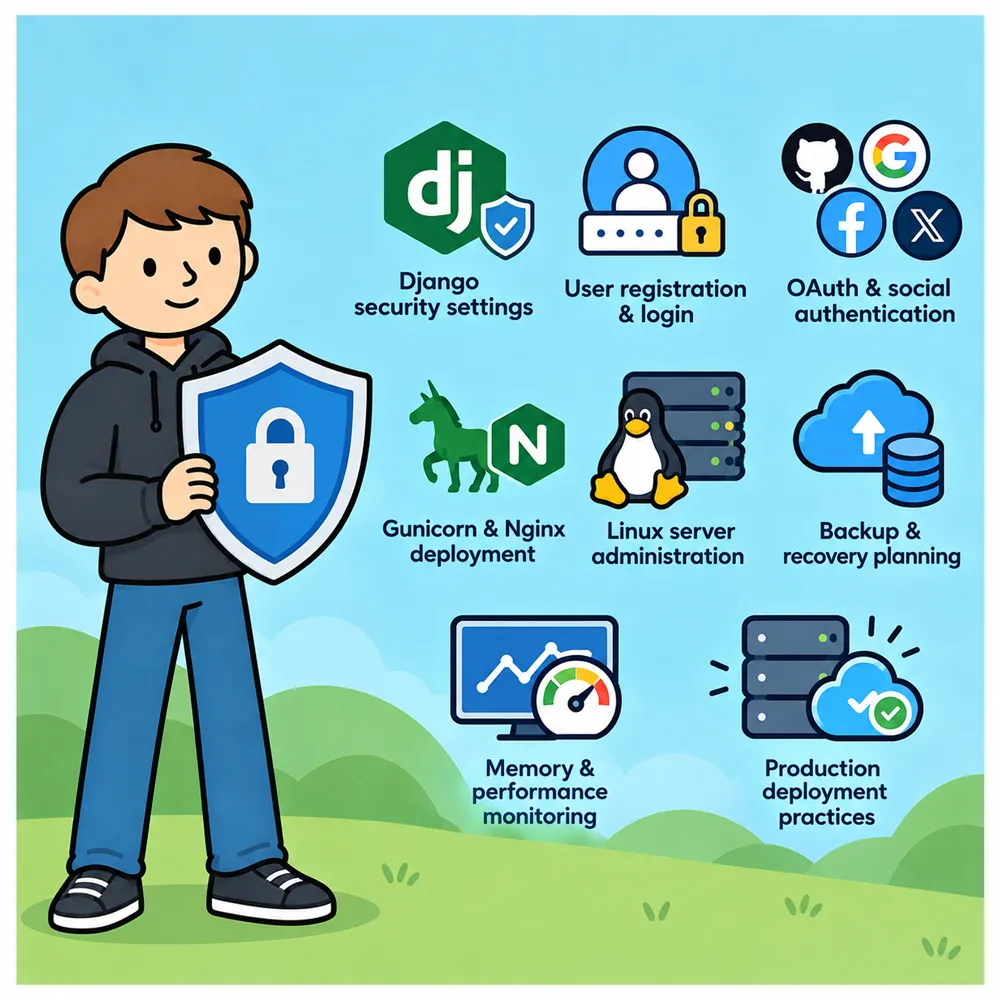
Our projects include practical security measures throughout application development, deployment, and server administration, with particular attention to protecting user data and reducing common attack surfaces.
For Django applications, we configure production security settings appropriately, including allowed hosts, CSRF protection, session security, password handling, secure configuration, and other framework-level protections.
We secure registration and authentication systems with appropriate validation, access controls, protected resources, and permission handling. When projects require external identity providers, we also work with OAuth and social authentication.
On the server side, we use Gunicorn and Nginx with clear separation between the application and web-server layers. Production services are configured to limit unnecessary exposure and keep application components isolated where appropriate.
Linux server administration also involves practical security work, including file and service permissions, environment management, controlled access to production resources, and careful configuration of running services.
We maintain backup and recovery practices for application data and databases, considering not only routine backups but also whether the data can actually be restored when something goes wrong.
Security also overlaps with reliability. We monitor memory usage, application performance, and server resources to identify abnormal behavior, resource problems, and other issues before they develop into larger production failures.
The approach is practical rather than theoretical: reduce unnecessary exposure, protect the parts that need protection, keep recoverable backups, and pay attention to what the production system is actually doing.