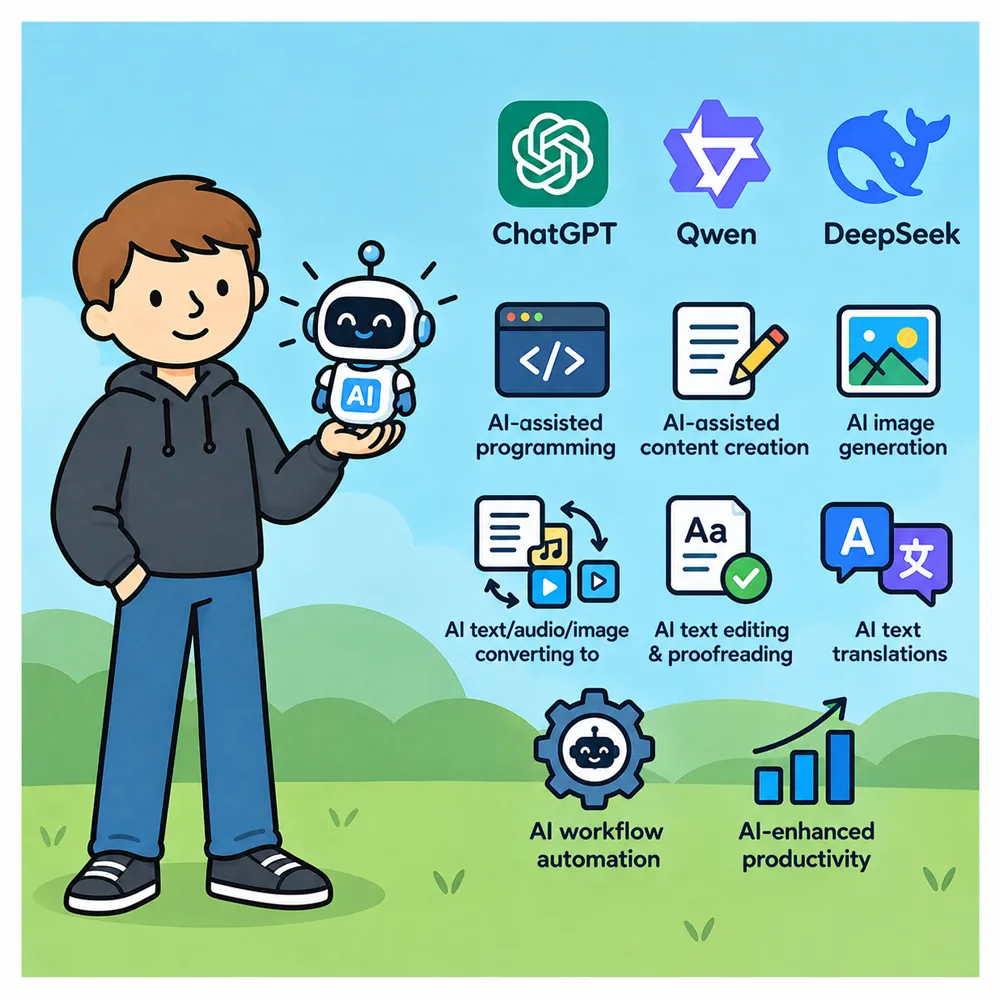
Our projects use AI tools such as ChatGPT, Qwen, and DeepSeek as practical development and content-production assistants. We integrate AI into everyday workflows rather than treating it as a standalone technology.
We use AI-assisted programming to explore solutions, generate and refactor code, troubleshoot errors, explain unfamiliar technologies, and speed up development. The generated results still go through testing, validation, debugging, and final implementation by us.
For content work, we use AI for drafting, rewriting, proofreading, summarization, SEO improvements, and adapting content for different audiences and languages. We also use AI-assisted translation, reviewing the results for accuracy, terminology, tone, and context rather than relying on automatic translation without checking it.
AI is also used for image generation and multimodal work, including converting and extracting information between text, images, and audio. Depending on the project, this can include generating visual assets, processing source material, or turning information from one format into another.
Some workflows combine several AI-assisted steps, such as generation, editing, translation, conversion, and automation. This helps reduce repetitive work and move faster from an initial idea or source material to a finished deliverable.
The tools and models change quickly, but the principle stays the same: AI does the repetitive and exploratory work, while we provide the technical knowledge, creative direction, quality control, and final decisions.